📊 Kalshi faces Iran market backlash
Plus: Polymarket insider makes $493K on Iran bet, and $50K lost on Kalshi (New York wants answers)
GM. You’re reading PredictionDesk, the daily newsletter that helps you become a prediction markets expert in under 5 minutes.
Here’s what we got for you today:
💀 Kalshi's "out as Supreme Leader" market didn't count the most obvious way out
💰 Who protects prediction market users?
📈 Market Moves
📊 Odds & Ends

KALSHI KILLS THE BET, NOT THE AYATOLLAH 💀
When Iranian state media confirmed Ayatollah Ali Khamenei's death in Israeli and U.S. strikes early Saturday morning, Kalshi's "Ali Khamenei out as Supreme Leader?" market was already at 68% and climbing. Within hours, the platform invoked a clause in its WLEADEROUT contract terms: if the leader "leaves solely because they have died," the market doesn't pay out at $1. Instead, positions settle at the last traded price before death, which Kalshi pegged at 1:14 AM Eastern. Nearly $55 million had been traded on the contract.
CEO Tarek Mansour took to X to explain. "No user will lose a dollar in this market," he wrote, outlining the remedy: refund all trading fees, settle pre-death positions at the last traded price, and fully reimburse users who opened positions after death was confirmed. The Wall Street Journal reported the total cost to Kalshi at $2.2 million. Mansour framed it as principle over profit, saying Kalshi designs its rules "to prevent people from profiting from death."
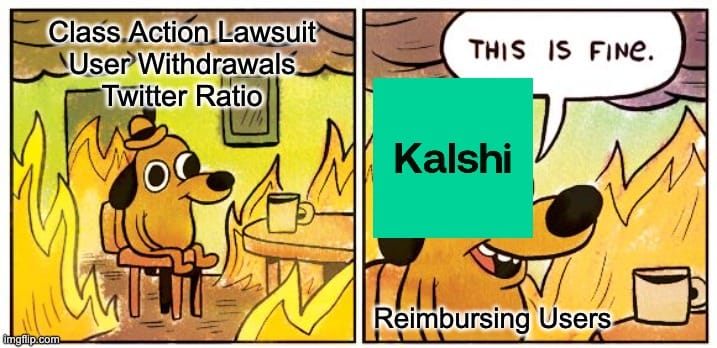
Users didn't see it that way. Within hours, the Ideas section on Kalshi's platform filled with people discussing a class action. The core complaint: if you buy "Khamenei out as Supreme Leader" and he's killed in a military strike, the most natural reading is that he is, in fact, out. Settling at the last pre-death price instead of $1 felt like a retroactive rule change to traders who'd bought a seemingly straightforward contract, even if the carveout was technically in the terms all along.
Under 17 CFR § 40.11, CFTC-registered exchanges can't list contracts involving terrorism, assassination, or war. A market that pays $1 when a head of state is killed in a military strike would be hard to defend under that standard. The death carveout is Kalshi's attempt to thread the needle: offer a politically relevant market while keeping settlement mechanics on the right side of the regulation. Whether that's principled contract design or a bait-and-switch depends on whether you're reading the fine print or the market title.
Polymarket, operating offshore without the same CFTC constraints, listed far more granular Iran-related contracts and saw $529 million in volume tied to the strikes, per Bloomberg. Bubblemaps flagged wallets that collectively made roughly $1.2 million in suspiciously well-timed trades. Kalshi's regulated status is supposed to be its competitive advantage, but when regulation forces you to void the most obvious outcome of your own market, that advantage starts looking like a liability.
This is the hardest design problem in prediction markets: how do you build contracts around geopolitical events when the most consequential outcomes are exactly what U.S. law says you can't settle on? Kalshi ate $2.2 million to make traders whole, and that might satisfy the CFTC. It won't satisfy users who thought they'd bought a straightforward contract and got a forced unwind instead. If Kalshi wants to be the trusted, regulated alternative to offshore platforms, it needs users to actually trust that markets resolve the way they look like they should.

THE ADDICTION STORY THE INDUSTRY CAN'T IGNORE 💰
Newsday just published a feature this week on Long Islanders spiraling into debt through prediction market platforms. A 21-year-old college student from Melville estimates he lost $50,000 over two and a half years betting through Kalshi, Polymarket, and other apps. At one point, he was pulling advances from nine different paycheck apps and depositing the money straight into prediction markets. Another member of Gamblers Anonymous Long Island, a 33-year-old from Massapequa, said he lost $100,000 in seven months and is sitting on $50,000 in credit card debt and $20,000 in personal loans.
The addiction angle is one the industry has largely avoided confronting. Advocates point out that prediction markets lack the responsible gambling safeguards required of state-licensed sportsbooks, and New York's voluntary self-exclusion program doesn't cover them. That gap is already fueling class-action lawsuits against both Kalshi and Polymarket. The Family & Children's Association in Garden City says it's seen a 10% year-over-year increase in problem gambling cases, with clients trending younger as 18-year-olds gain access to platforms that traditional sportsbooks would gate behind a 21+ age requirement.
The regulatory backdrop makes this messier. New York AG Letitia James issued a consumer alert days before the Super Bowl warning that "unregulated prediction markets" lack consumer protections. The state Gaming Commission sent Kalshi a cease-and-desist in October, and Kalshi responded by suing. Then, earlier this month, the federal government filed in a Nevada lawsuit backing Kalshi and Polymarket, with CFTC Chairman Michael Selig declaring: "To those who seek to challenge our authority in this space, let me be clear. We will see you in court."

CFTC Chairman Michael Selig
That federal filing is significant because it represents the CFTC planting its flag more aggressively than at any point during this jurisdictional tug-of-war. Previous CFTC leadership had been content to let courts sort it out. Selig's statement reads like the agency is done deferring, which is good news for Kalshi and Polymarket's argument that they're federally regulated financial exchanges, not state-regulated gambling operations.
The problem for the industry is that stories like these erode the "financial instrument" framing faster than any legal brief. A college kid maxing out credit cards and pulling paycheck advances to bet on Premier League soccer through Kalshi looks a lot more like a gambling addiction than an informed market participant pricing risk. State regulators will use exactly this kind of coverage to argue that federal oversight alone isn't protecting consumers, and the longer the platforms go without meaningful responsible-use guardrails, the stronger that argument gets.

MARKET MOVES 📈
📈 Biggest swing: “ChatGPT Outage by February 28?” moved 22% → 100% (Polymarket)
💰 Top earner: @0x492442EaB586F242B53bDa933fD5dE859c8A3782-1766317541188 - $149,249 24H Profit (Polymarket)
🤔 Weirdest market: “February Unemployment Rate - Mexico” (Polymarket)

ODDS & ENDS 📊
Alleged insider on Polymarket profits $493K from the US strikes on Iran.
Kalshi leads prediction markets in monthly volume with $10B.

RATE TODAY’S EDITION